
Professor Alberto Sangiovanni Vincentelli is the Edgar L. and Harold H. Buttner Chair of Electrical Engineering and Computer Sciences at the University of California, Berkeley, a member of BAIR (Berkeley Artificial Intelligence Research) Lab, Chairperson of the Berkeley SkyDeck Accelerator Academic Advisors, the special advisor of the Dean of Engineering, for entrepreneurship and is the President of Chips.it, the 250MEuro Foundation of the Italian Government to foster integrated circuit design. He is an author of over 1000 papers, 17 books and 3 patents. He is an IEEE and ACM Fellow, a member of the National Academy of Engineering and of the American Academy of Arts and Sciences. He is a co-founder of Cadence and Synopsys, the two leading companies in Electronic Design Automation. He is Chairperson of Exein, Quantum Motion, Phononic Vibes, Innatera and e4Life. Member of the Board of Cadence, KPIT and Helmon. He is the recipient of the IEEE/RSE James Clerk Maxwell Medal and the 2023 BBVA Frontiers of Knowledge Award and holds four Honorary Doctorated.


Professor Alberto Sangiovanni-Vincentelli
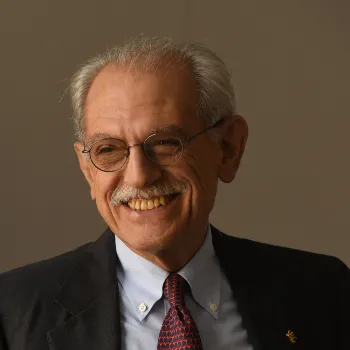
The Edgar L. and Harold H. Buttner Chair, Electrical Engineering and Computer Science, University of California, Berkeley
Professor Alberto Sangiovanni-Vincentelli
  • Professor Alberto Sangiovanni-Vincentelli

    Over the past fifty years, I have had the privilege of living through, and participating in, an extraordinary transformation of technology, from the early days of integrated circuits and computer-aided design to today's world of artificial intelligence and intelligent systems. I began my career as a theoretician, fascinated by mathematical methods for the analysis and design of complex systems, with no intention of becoming an entrepreneur. Yet research carried me from Italy to Berkeley, from theory to algorithms and software, and eventually to the creation of companies that helped establish Electronic Design Automation as a major industry. This journey taught me that the boundaries between fundamental research, engineering, and entrepreneurship are far more permeable than we often imagine.


    In this lecture, I will use episodes from my own fifty-year journey to reflect on how ideas become technologies and, occasionally, industries. I will discuss the role of universities and their interaction with industry, the birth and evolution of EDA, the experience of creating and growing technology companies, and the importance of people, timing, risk, and serendipity. I will also look forward to the opportunities created by artificial intelligence and the next generation of complex engineered systems. My central message is that entrepreneurship need not be a departure from intellectual inquiry: at its best, it is another way of transforming ideas into reality and of discovering new and deeper questions along the way.

    Read more