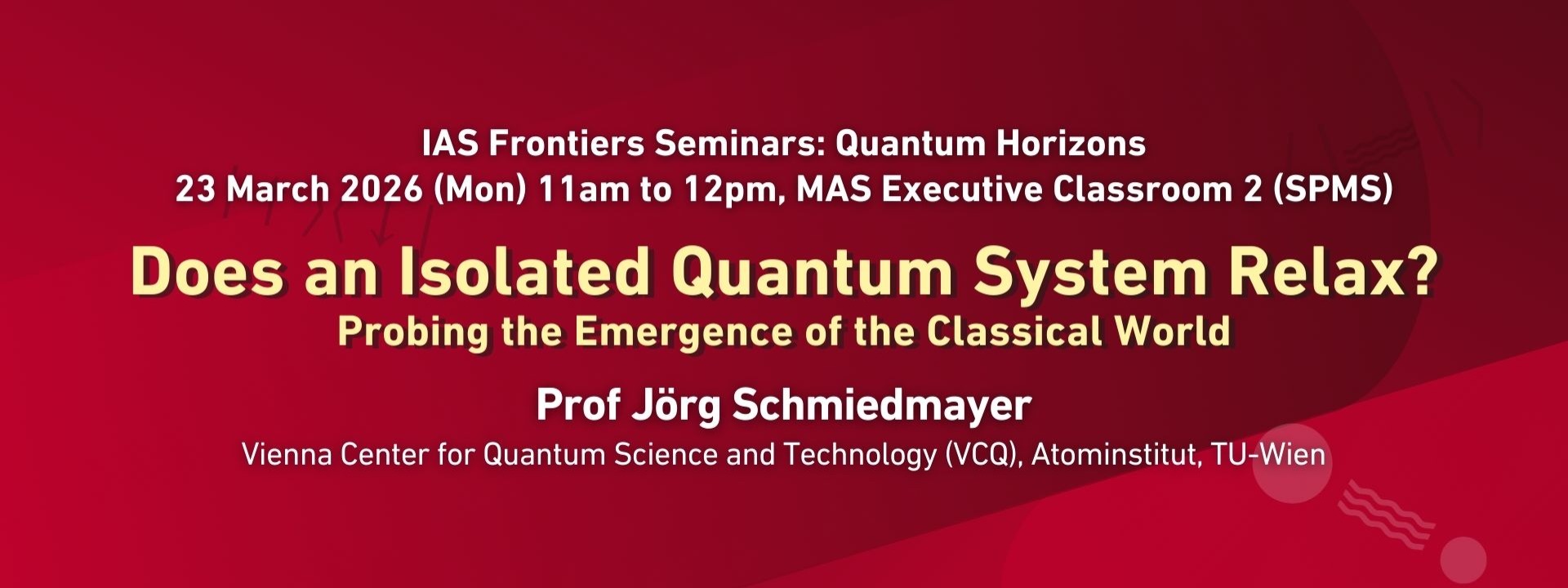
PLEASE NOTE: Time and venue for this seminar has been changed to:
11am to 12noon at MAS EC 2
About the talk
The evolution of an isolated quantum system is unitary. This is simple to probe for small systems consisting of few non-interacting particles. But what happens if the system becomes large and its constituents interact? In general, one will not be able to follow the evolution of the complex many body eigenstates.
Ultra-cold quantum gases are an ideal system to probe these aspects of many body quantum physics and the related quantum fields. Our pet systems are one-dimensional Bose-gases. Interfering two systems allows studying coherence between the two quantum fields and the full distribution functions and correlation functions give detailed insight into the many body states and their non-equilibrium evolution.
In our experiments, we study how the coherence created between the two isolated one-dimensional quantum gases by coherent splitting slowly degrades by coupling to the many internal degrees of freedom available [1]. We find that a one-dimensional quantum system relaxes to a pre-thermalised quasi steady state [2] which emerges through a light cone like spreading of ’de-coherence’ [3]. The pre-thermalized state is described by a generalized Gibbs ensemble [4]. Finally, we investigate the further evolution away from the pre-thermalized state. On one side, we show that by engineering the quasi particles we can observe many body quantum revivals [5]. On the other, we point to mechanisms [6,7] that lead towards a final state that appears indistinguishable from a thermally relaxed state: two classically separated objects. This illustrates how classical physics can emerge from unitary evolution of a complex enough quantum system.
Work performed in collaboration with the groups of E. Demler (Harvard/ETHZ), Th. Gasenzer und J. Berges (Heidelberg)., J- Eisert (FU-Berlin) Supported by the Wittgenstein Prize, the DFG-FWF: SFB ISOQUANT: and the EU: ERC-AdG QuantumRelax and Emergence in Quantum Physics (EmQ)
[1] S. Hofferberth et al. Nature, 449, 324 (2007).
[2] M. Gring et al., Science, 337, 1318 (2012); D. Adu Smith et al. NJP, 15, 075011 (2013).
[3] T. Langen et al., Nature Physics, 9, 640–643 (2013).
[4] T. Langen et al., Science 348 207-211 (2015).
[5] B. Rauer et al. Science 360, 307–310 (2018).
[6] T. Schweigler et al., Nature Physics 17, 559 (2021),
[7] S. Aminet et al. Nature Physics 21, 1326 (2025)
About Speaker
Prof Jörg Schmiedmayer is a leading experimental quantum physicist and Professor of Physics at TU Wien, heading the Atom and Quantum Optics Group at the Atominstitut and co-leading the Vienna Center for Quantum Science and Technology (VCQ). He pioneered atom-chip technology and matter-wave interferometry, advancing research in ultracold atoms, Bose–Einstein condensates, and non-equilibrium quantum systems. His work has earned him multiple ERC Advanced Grants, the Wittgenstein Prize, and international recognition for contributions to quantum simulation, quantum optics, and many-body physics.