About the talk
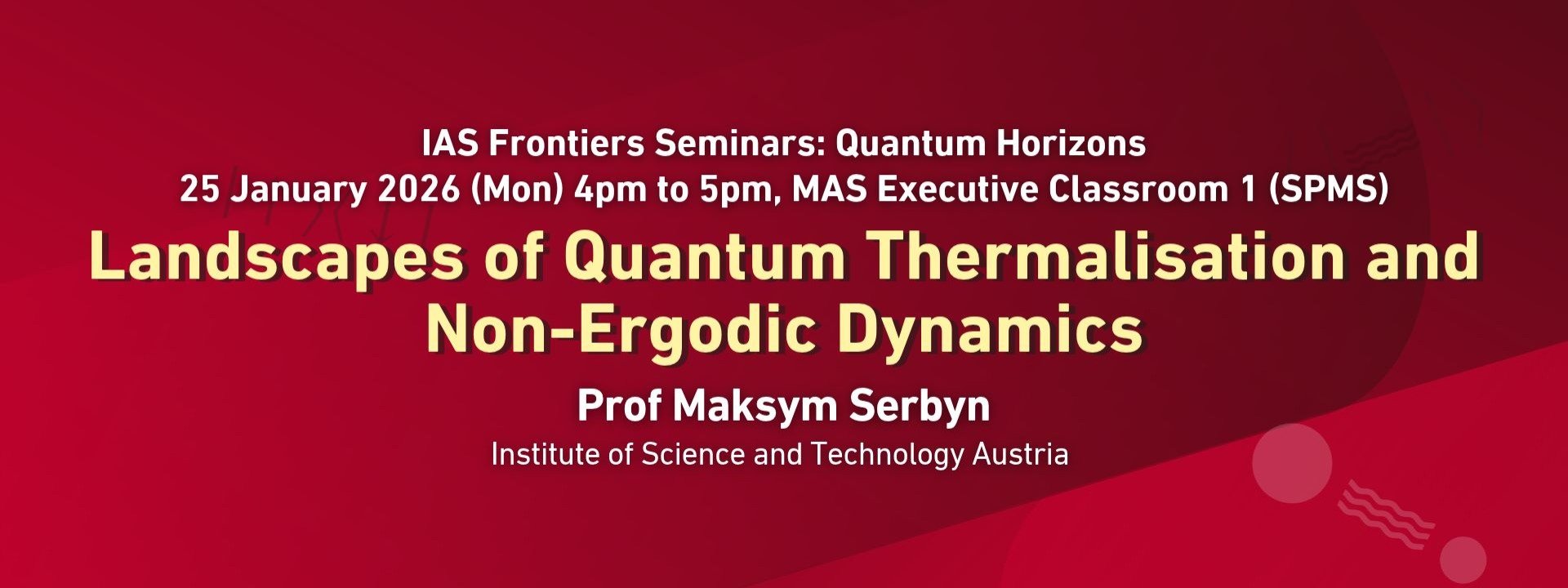
In this seminar, I will focus on out-of-equilibrium many-body quantum systems. In contrast to low-energy states, described through the notion of phases of matter, our understanding of out-of-equilibrium properties is in its infancy. A natural coarse classification comes from the approach to thermal equilibrium: generic systems thermalize in accordance with the eigenstate thermalisation hypothesis, erasing local memory of their initial state. Yet striking exceptions exist. I will survey the landscape of quantum thermalisation and the mechanisms of its failure. Many-body localisation provides the paradigmatic strong ergodicity breaking, where disorder entirely arrests thermalisation and preserves local memory. Quantum many-body scars offer a weaker violation, in which rare non-thermal eigenstates coexist with an otherwise thermalizing spectrum. I will also discuss how slow non-ergodic dynamics emerges near first-order quantum phase transitions. Beyond classification, these failures of thermalisation enable genuinely new out-of-equilibrium phenomena, including discrete time crystals and coherent dynamical order. These phases have no equilibrium analog and are directly accessible in current quantum simulators. I will conclude by outlining a broader perspective, in which non-ergodic points serve as organising centers that structure the landscape of thermalisation and its timescales.
About the speaker
Maksym Serbyn received his PhD from MIT in 2014. After a postdoctoral position at UC Berkeley, he joined the Institute of Science and Technology Austria (ISTA) in 2017 as an assistant professor and was promoted to professor in 2022. Maksym is best known for his work on non-equilibrium quantum systems, including many-body localisation and quantum many-body scars.