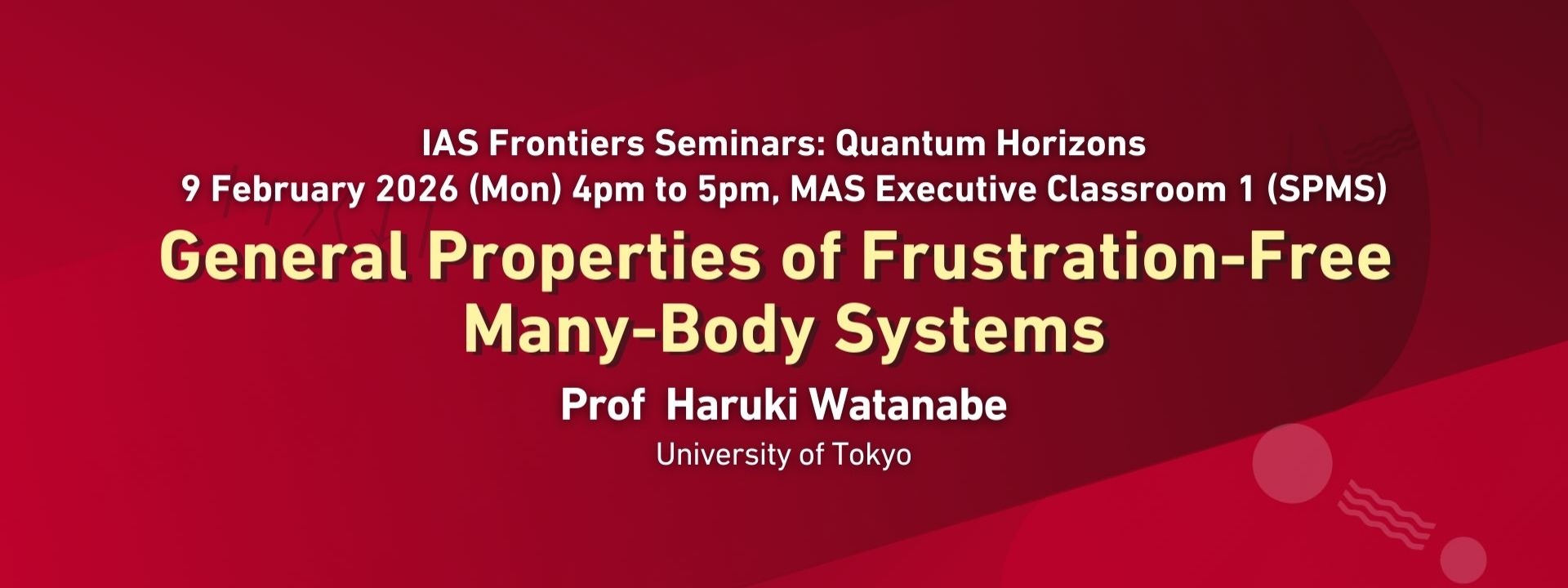
Join us at this seminar by Prof Haruki Watanabe from University of Tokyo. This seminar is organised as part of the IAS Frontiers Seminars: Quantum Horizons, jointly supported by the Institute of Advanced Studies (IAS) and School of Physical and Mathematical Sciences (SPMS).
About the talk
Frustration, much like symmetry, fundamentally constrains the behavior of quantum many-body systems. A frustration-free Hamiltonian, in which every local term is simultaneously minimized by the ground state, imposes a strong local constraint that leads to phenomena rarely seen in generic frustrated models. For instance, gapless frustration-free systems typically display an unusually small finite-size gap scaling as O(1/L^2). Conversely, gapped systems can sustain exact ground-state degeneracy on finite systems, allowing for the spontaneous breaking of continuous U(1) symmetry even in one dimension. Frustration-freeness also exhibits a non-trivial interplay with topology; it is widely believed, for example, that a finite-range frustration-free Hamiltonian cannot host a Chern insulator.
In this talk, I will review these universal properties and present our recent results. I also will discuss a rigorous lower bound on the dynamical critical exponent of the kinetic Ising model, derived by mapping its stochastic dynamics to a frustration-free quantum Hamiltonian. Finally, I will extend these ideas to free-fermion systems and classify the topological band structures realizable in frustration-free free-fermion systems.
About the speaker
Haruki Watanabe is a leading theoretical physicist specialising in condensed matter theory and quantum many-body systems. He earned his BA and MS degrees with honours from the University of Tokyo and completed his PhD at the University of California, Berkeley under Ashvin Vishwanath’s supervision. After a postdoctoral fellowship at MIT as a Pappalardo Fellow, he joined the Department of Applied Physics at the University of Tokyo. Prof Watanabe’s contributions have been recognised with numerous honours, including the 2025 Particle Medal, 2022 New Horizons in Physics Prize, 2017 Condensation Science Prize, and the 2016 Nishinomiya Yukawa Memorial Award. Starting this March, he will join the Hong Kong University of Science and Technology as a Professor of Physics and an IAS Professor.