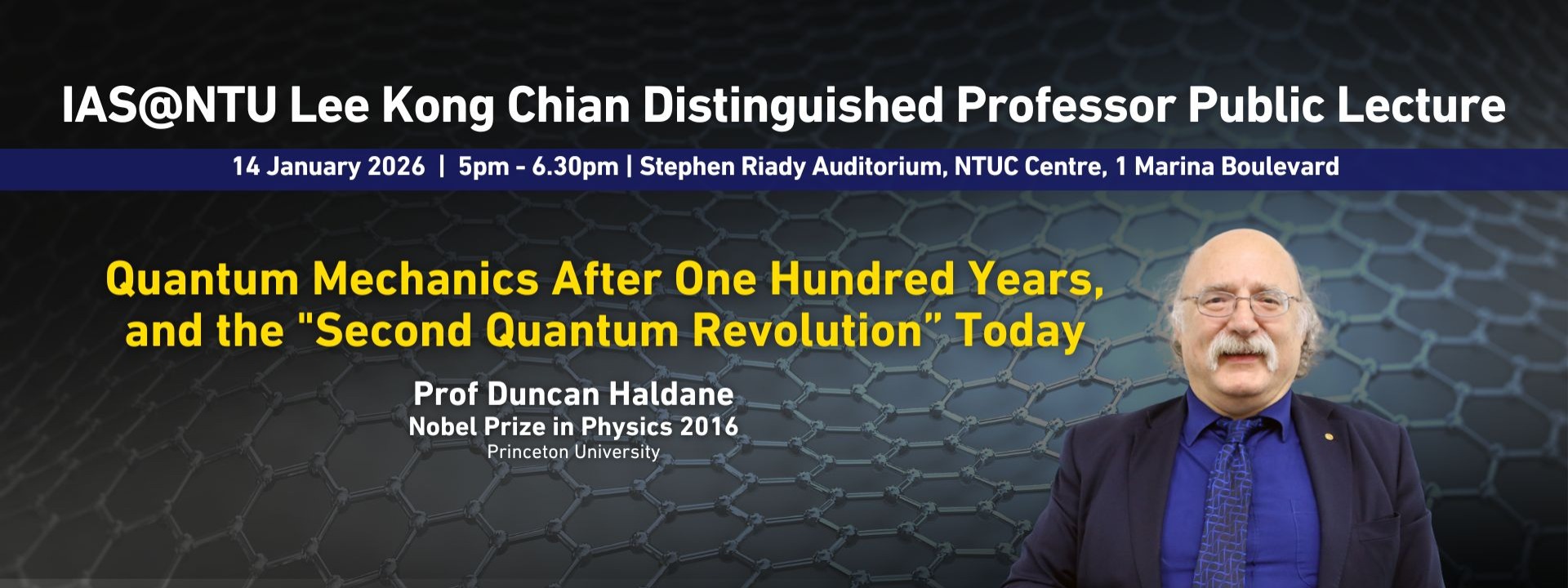
Quantum Mechanics After One Hundred Years, and the "Second Quantum Revolution" Today
To celebrate the 100'th birthday of modern quantum mechanics, UNESCO designated 2025 as the "International Year of Quantum Science and Technology". But while the fundamental laws of quantum mechanics, as we know them, have not changed since then, our appreciation of the strange things quantum mechanics allows has greatly increased in recent years, leading to what has been called the "second quantum revolution", where "quantum entanglement" (which Einstein famously ridiculed as "spooky action at a distance") has not only been experimentally verified, but has come to be seen as the key property of quantum mechanics, and is at the heart of the current pursuit of new quantum technologies.
About the speaker [More info]
Prof Duncan Haldane, who shared the 2016 Nobel Prize for Physics with David Thouless and Michael Kosterlitz, is the Sherman Fairchild University Professor of Physics at Princeton University, who is a Fellow of the Royal Society of London, and of the U.S. National Academy of Sciences, and the Slovenian Academy of Sciences and Arts (foreign member) He is also a Fellow of the American Academy of Arts and Sciences, the American Association for the Advancement of Science, and the American Physical Society.
He was awarded a share of the Nobel Prize for his theoretical work on “topological states of matter”, including pioneering work on unexpected (and initially controversial) “topological quantum states” of one-dimensional systems of magnetic atoms (for which he had previously received the 1993 Oliver Buckley Prize of the American Physical Society), and on the theoretical prediction of (ferromagnetic) topological insulators (exhibiting the “quantum anomalous Hall effect”, finally first observed experimentally in 2013) for which he had shared the 2012 Dirac medal of the International Center for Theoretical Physics (Trieste) with Charles Kane and Shou-Cheng Zhang. His work helped to open up new directions and ways of thinking about quantum effects in condensed matter, and in recent years, “topological quantum matter” has grown into a very active experimental field which many believe may provide platforms for “quantum computing”. He also initiated the field of “topological photonics”. He currently works on “quantum geometry” in the “fractional quantum Hall effect”.
Haldane received his PhD in theoretical condensed matter physics from Cambridge University, under the direction and mentorship of Philip W. Anderson (Nobel Laureate in Physics 1977), and, before his appointment at Princeton University, worked at the Institut Laue-Langevin (Grenoble, France), the University of Southern California, Bell Laboratories, and the University of California, San Diego, in the U.S.A. Haldane was born in London in 1951, with mixed Scottish and Austrian/Slovenian origins, and was educated at St. Pauls school, then Christ’s College, Cambridge.